Owner briefing · US list prices read from each vendor's page, 11 November 2026
Three contracts a restaurant signs without reading
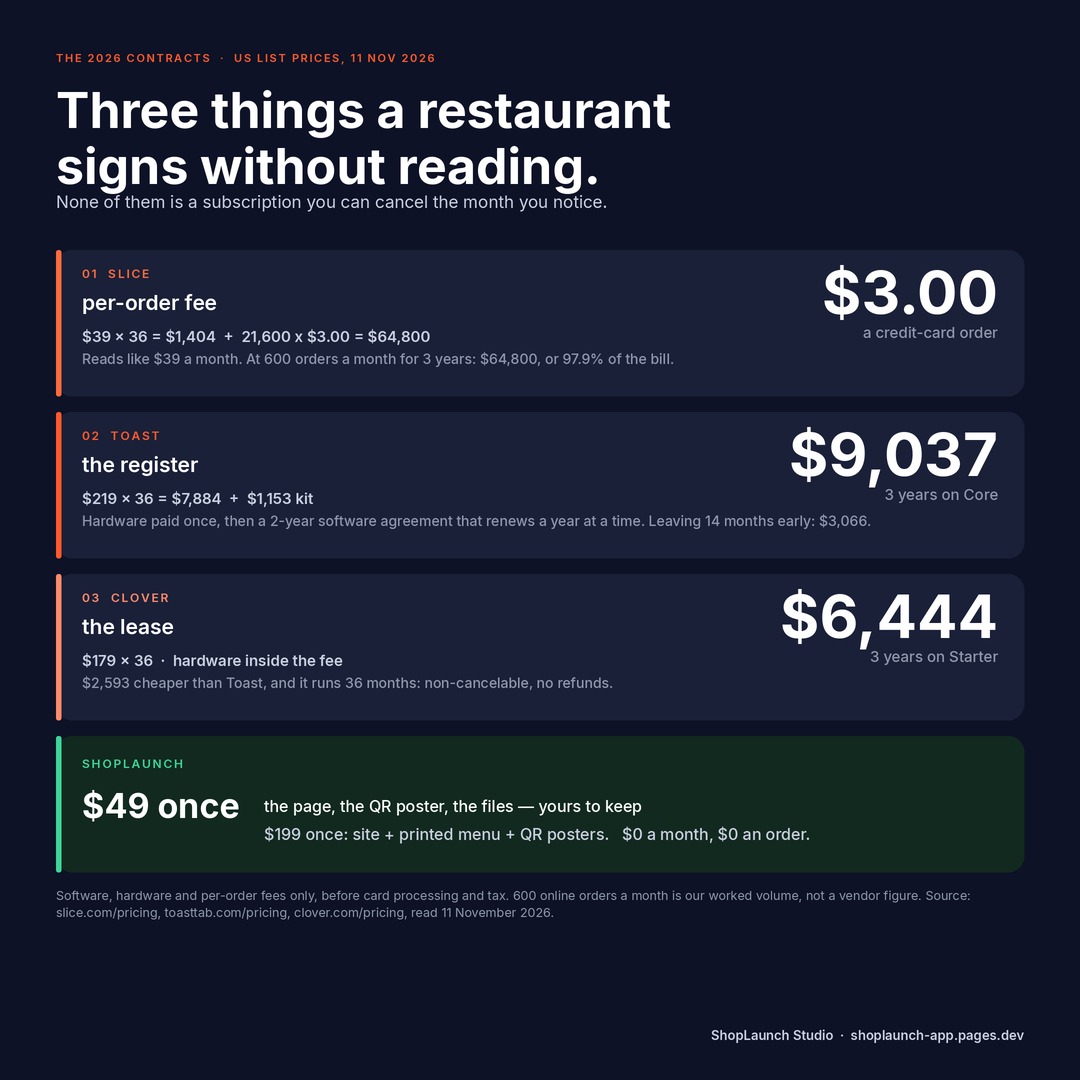
Each one is sold on a headline you can hold in your head — $39 a month, $219 a month, $179 a month. The bill is not made of that number. One is a toll on every order, one is a two-year software term behind a $1,153 kit, one is a 36-month lease that cannot be cancelled. Priced at 600 orders a month for three years they come to $66,204, $9,037 and $6,444 — and the number a shop actually feels is the one nobody asks for: what leaving on month 14 costs.
Every figure comes from the vendor's own published pricing page or its own terms, read on 11 November 2026: slice.com/pricing, toasttab.com/pricing and its Starter Kit checkout, clover.com/pricing/restaurant and Clover's pricing FAQ. These are US list prices, before tax and before card processing — a card rate of 2.90% + 30¢ at Slice, 2.49% + 15¢ at Toast, 2.3% + 10¢ at Clover is charged on top of every number here. It is not a quote from any of the three, and your agreement can differ: negotiated rates, reseller and bank pricing, and annual increases are all common, and Clover states outright that termination terms vary by the institution selling the system. What this page can do is show you which line grows, which term binds, and what to ask for in writing.
One number is ours, not theirs: 600 orders a month. That is 20 a day, an ordinary Friday-and-Saturday pizzeria, and it is the volume we use everywhere on this site. It matters for exactly one of the three. Toast and Clover charge a flat monthly price that does not care how busy you are; Slice charges a flat price and a fee on every order, so at 600 orders a month the arithmetic multiplies. Over three years that is 21,600 orders.
Read the three sections in order and a pattern appears. The headline price is the smallest number on each page. The number that decides the bill is a rate, a term length, or a lease — something that is printed in the agreement and not on the pricing page, and something a salesperson has no reason to put in the email.
Contract 01 · the per-order toll
Slice: a monthly fee you can cancel, and a rate you cannot
The subscription is the receipt. The $3.00 is the price.
Slice · Online Growth
$39 a month, plus $3.00 on every credit-card order
$66,204three years at 600 orders a month
Slice sells two memberships. Online Growth at $39 a month is the website, online ordering and a listing in the Slice app, with $3.00 on every credit-card order. Complete Growth at $99 a month adds a register, phone ordering and hardware, and charges $2.00 on every online or phone order, plus a $1,000 implementation fee paid once. Neither charges the per-order fee on orders under $10, and both are month to month.
36 months × $39$1,404
21,600 orders × $3.00$64,800
Three years, Online Growth$66,204
the per-order line as a share of that bill97.9%
That last line is the whole argument. The subscription is 2.1% of what the shop pays. On a $25 pizza the fee is 12% of the ticket; on a $19 order it is 15.8%. It is charged whether the order came from a stranger who found you in the app or the family that has phoned every Friday for nine years — the regulars are the orders this fee costs you most, because they were already yours. At 600 orders a month, year two costs $22,068, and year three costs $22,068 again.
The cheaper Slice plan in three-year terms is Complete Growth at $47,764 — 36 × $99 plus the $1,000 implementation, plus 21,600 orders at $2.00 — which is $18,440 less than Online Growth and still 90% per-order fee. If you are comparing Slice with a one-time page, the gap to our $199 Local Pack is $47,565 at the cheaper plan and $66,005 at the one the shop is most likely to be sold.
The part this page has to be honest about
Slice's contract is the best of the three to be inside, and it would be strange to pretend otherwise: month to month, no exit fee, no minimum term. If you leave, you leave. What you cannot leave is the rate while you are there, the card processing stacked on top of it, and the fact that the site and the menu live inside Slice's system — so the honest question before you sign is not "can I cancel", which the pricing page answers, but "what do I keep if I do". Ask that in writing, and ask what your Google listing and your regulars' saved link point at afterwards.
Where Slice is the better buy
If you want orders rather than a menu — its app, its Google listing work and its marketplace put your shop in front of people already ordering pizza — $3.00 on a $25 order is a third of DoorDash's 25% delivery commission, and there is no term to escape. This section exists because a pizzeria comparing Slice with a two-year register lease should see that one of the three lets it walk out, and price the fee with its eyes open.
The kit is yours. The software is not, and the second year is where the exit gets priced.
Toast · Core, Traditional
$219 a month, on a 2-year software agreement
$9,037three years at Core
On Traditional pricing a single location pays $69 for Basic, $219 for Core — the plan that adds online ordering and delivery integrations — and $578 for Growth, which is the pack that adds the Toast website, gift cards, loyalty, SMS and email marketing. On top of the plan, the countertop kit is $1,153 up front: the Flex terminal, the Tap card reader and the router. The hardware is yours, not leased. The software is the part with a term.
36 months × $219$7,884
Countertop kit, paid once$1,153
Three years, Toast Core$9,037
the website, at Growth, for the same three years$21,961
Month 1Month 24Year 3 onward
The first two years are the term. After it, the agreement renews a year at a time unless either side gives 30 days' written notice — so the shaded year is the one you have to remember to end.
Toast's checkout states the 2-year software agreement, and that recurring charges start the day you go live. Leaving early costs the software fees left in the term. Fourteen months left at Core is 14 × $219 = $3,066. The same exit at Growth is $8,092. On Pay-as-You-Go, where there is no monthly software fee and you pay 3.09–3.69% + 15¢ per card instead, the exit is $150 for each month left — $2,100 at 14 months, whatever pack you are on.
Two clauses are worth reading twice, because they are the ones that bind the rest of your stack. First, the terms say the service may only be used on approved Toast hardware — the register and the software come as one object, so the terminal is not a thing you can keep using with someone else's software. Second, the website is not in the base plan. It arrives at Growth, $578 a month, which is $21,961 over three years; a shop already on Core adds ordering through a Digital Storefront add-on whose price does not appear on the pages we read.
The month-14 problem, stated plainly
Fourteen months is not an arbitrary number. It is roughly when an owner discovers that the system is not the one they were promised, and it is late enough that the remaining term is worth more than the cost of switching. At that exact point Toast's exit is $3,066 — sixty times the price of the $49 page. The clause is not hidden; it is in the agreement you are asked to sign while the terminal is already on the counter.
Clover: the cheapest three years, and the longest sentence
$2,593 less than Toast over three years — and twelve months more you cannot leave.
Clover · full-service Starter
$179 a month for 36 months, hardware inside
$6,444three years, non-cancelable
Clover prices a whole system rather than a licence: the Station Solo, the cash drawer and the receipt printer are inside the monthly, with the Restaurant software plan on top. Starter is $179 a month for 36 months; Standard, with a handheld for tableside ordering, is $239 ($8,604 over three years); Advanced, with a customer-facing screen, is $354 ($12,744). Card-present processing is 2.3% + 10¢ — the sharpest rate of the three — and it is separate from all of it.
36 months × $179$6,444
hardwareinside the fee
Three years, Clover Starter$6,444
against Toast Core, same three years$2,593 cheaper
Month 1Month 36
One term, not two: 36 months with no exit other than paying the rest of it off or upgrading — and 30 days' notice before the end if you want out.
Clover's own pricing FAQ is unusually direct about it: the subscription is non-cancelable and ineligible for refunds. You can pay the term off or upgrade; you cannot walk away. At the end of the 36 months you buy the equipment or return it, and if you do neither the subscription continues at the same monthly charge — which is why the notice date, not the end date, is the date to put in the calendar. Clover asks for 30 days' notice before the term ends, and states that termination terms vary by the bank or reseller selling the system.
There is a second way to buy the same hardware: pay for it up front and keep paying a software fee — $1,799 down and $89.95 a month on Starter, which is $5,037 over 36 months. That is $1,407 less than the bundle, and it buys a shorter exposure to a subscription you cannot cancel. It is worth asking for, because the bundle is what gets quoted.
Where Clover is the better buy
If you need a register, Clover is a legitimate answer: hardware inside the price, the lowest card-present rate here at 2.3% + 10¢, and an online menu page with no-fee ordering included. On the published numbers it is also the cheapest of the three over three years. The question this page asks is narrower than that — it is what the 36 months cost you if the thing you dislike is the register, and whether the website should have been attached to it at all.
Side by side, including the line none of them quotes
Cost to leave at month 14 is the row to read first. It is the only row that is about you rather than about the product.
Slice · Online Growth
Toast · Core
Clover · Starter
ShopLaunch
List price
$39/mo + $3.00 an order
$219/mo + $1,153 kit
$179/mo, hardware inside
$49 once (page) · $199 once (Local Pack)
What recurs
The monthly, and the fee on every order
Software, 24 months, then yearly
36 months, non-cancelable
Nothing
Minimum term
None — month to month
2 years
36 months
None
Cost to leave at month 14
$0 in fees — ask what survives
$3,066
$3,938 (22 months), or a buyout
$0 — nothing to cancel
Three years at 600 orders
$66,204
$9,037
$6,444
$199
Per-order cut
$3.00 credit-card · $2.00 Complete
None
None
None — we take no orders
Website included
Yes, inside Slice's system
Only at Growth, $578/mo
A menu page, not a designed site
Yes — the page and the files are yours
Card processing
2.90% + 30¢ extra
2.49% + 15¢ extra
2.3% + 10¢ extra
Your own processor, untouched
What you keep if you leave
A site inside their system — ask
The terminal; not the software
Buy the equipment or return it
The page, the PDFs, the PNGs, the link
US list prices read 11 November 2026, before tax and before card processing. The month-14 figures are the vendors' stated exit rules applied to a 14-month exit: Toast 14 × $219 on Core Traditional; Clover 22 months of the 36 remaining, where a buyout or upgrade may be cheaper and only the seller can quote it; Slice has no exit fee, so the open question is the site rather than the money.
The pattern under all three
Each agreement is priced so that the expensive part arrives after the decision. For Slice the expensive part is a rate that grows with your best week and a site that lives inside their system. For Toast it is a second year that is worth more than the cost of leaving. For Clover it is a 36-month term you cannot cancel and equipment you must buy or return. None of that makes them bad products — all three sell something real. It makes them contracts, and a contract is read before it is signed or priced after.
Before the salesperson leaves
Four questions that turn a quote into a contract
Ask all four in the meeting, and ask for the answers in writing. A vendor who will not put the exit figure in an email has told you something too.
1
What is the minimum term, and what do I owe if I leave on month 14?
Not "can I cancel" — every salesperson says yes to that. The number, applied to a date, in dollars. Month 14 is the honest test: it is late enough that the salesperson has moved on and early enough that you might still want to.
What a good answer sounds like: "There is no minimum term" — or a figure, in writing, with the clause it comes from. A good answer is never "we'll work something out".
2
Which line on this bill grows when I have a good Friday?
A flat monthly fee is a cost you can forecast. A per-order fee is a cost that rises with the thing you are trying to do. Both can be right; only one is a ceiling. On the pages we read, Slice is the only one of these three with a per-order line.
What a good answer sounds like: "None — the monthly is the monthly", followed by the card-processing rate, which is the other line that moves with volume and is never in the headline price.
3
What do I keep if I leave — the site, the menu, the photos, the customer list, the domain?
This is the question the pricing page never answers. A website that stops working when a subscription stops is not an asset; it is a rental with your name painted on it. Ask about the domain separately: whose name is the registrant, and can you get the DNS records.
What a good answer sounds like: a list of files and a link, not a promise of "export help". If the answer is "we can send you a ZIP", ask what is inside the ZIP and whether the design survives it.
4
Who can raise the price, by how much, and what happens if I do nothing at the end?
Two clauses decide year three: the escalator, and the auto-renewal. Toast's agreement renews a year at a time unless either side gives 30 days' written notice; Clover says a subscription left running continues at the same monthly charge, and asks for 30 days' notice before the term ends. Neither is a trick — both are the reason the calendar reminder matters more than the price card.
What a good answer sounds like: the renewal date, the notice period, and whether the price is fixed for the term or indexed. Put the notice date in your calendar the day you sign, not the end date.
If you are weighing the three against a register you already own, the calculator runs your own order count and your own volume through all eleven platforms: the 2026 restaurant fee calculator →
If you already signed
The five steps that turn a bad contract into a dated plan
Nothing here needs a lawyer, and none of it requires a confrontation. It requires the agreement and an hour.
Find the term, not the invoice. The invoice shows the month. The agreement shows the start date, the length, the renewal rule and the notice period. Photograph the two pages that carry them; that is the document you will quote from.
Work out the exit number yourself. Months left × the monthly software fee on Toast, the full remaining balance on Clover, nothing on Slice. Write it down next to what switching would save over the same months — nine times out of ten the comparison answers the question, and the tenth time it tells you to wait.
Put the notice date in the calendar. Both Toast and Clover ask for 30 days' written notice before the term ends, and Clover's subscription continues at the same monthly charge if the term ends with nothing done. Set the reminder 60 days out so there is room to act.
Ask in writing for the numbers. "What is my remaining balance, is there a buyout, what happens to the website and my menu data at the end of the term, and what is the notice date?" A support ticket with those four questions is a record, and it is also how you discover the answer is different from what the salesperson said.
Do not simply stop paying. Cancelling a card does not cancel a term; it moves the dispute to a balance owed. If the numbers are unbearable, ask for the buyout or a downgrade to the cheapest plan that keeps the register working, and get the agreement in writing before the next charge.
Whatever you decide about the register, the page and the menu do not have to wait for the term to end. They are the part that is bought once and kept — which is the only thing this site sells. $49 is the page, the QR poster and the files; $199 adds the digital menu with a QR for every table, printed posters and the social posts. We do not sell a register, take payments or process orders, so none of it conflicts with the contract you are already in.
One payment, no term, nothing to leave
The three contracts above are about the systems a restaurant runs on. The page a customer taps is not one of them: hours, prices, photos, tap-to-call, a menu you change in a minute, and a QR poster for the tables — built from one five-minute form, live the next business day, and yours to keep.
At 600 orders a month, Clover's full-service Starter is the lowest three-year total at $6,444, then Toast Core at $9,037, then Slice Online Growth at $66,204 — 97.9% of which is the $3.00 per-order fee. Cheapest is not the same as least committed: Clover's $6,444 is a 36-month subscription that cannot be cancelled, Toast's $9,037 carries a 2-year term with a stated exit fee, and Slice's membership is month to month with no exit fee, which is the one genuine advantage among the three.
Is Slice really month to month with no exit fee?
Yes, according to Slice's own pricing page read on 11 November 2026: both memberships are month to month with no exit fee, and neither charges the per-order fee on online orders under $10. What you cannot cancel is the arithmetic — the $3.00 or $2.00 applies to every order while you use the plan, and the website and ordering run inside Slice's system, so ask in writing what survives cancellation before you rely on leaving.
What does leaving Toast at month 14 cost?
On Traditional pricing, leaving Core with 14 months left in the 2-year term costs the software fees left in the term: 14 × $219 = $3,066. On Pay-as-You-Go, where there is no monthly fee, the charge is $150 for each month left — $2,100 for 14 months. After the first two years the agreement renews a year at a time unless either side gives 30 days' written notice.
Can I cancel a Clover subscription?
No. Clover's own pricing FAQ says subscriptions are non-cancelable and ineligible for refunds. You can pay the term off or upgrade, and the pages we read say a request needs 30 days' notice before the term ends. At the end of the 36 months you buy the equipment or return it; if you do neither the subscription continues at the same monthly charge. Terms also vary by the bank or reseller selling the system, so the number on clover.com is not automatically yours.
Why 600 orders a month?
600 is 20 orders a day, an ordinary Friday-and-Saturday pizzeria, and it is our worked volume, not a vendor figure. It only changes Slice's line, because Toast and Clover are flat monthly charges that do not move with order count: 21,600 orders over three years is what turns $3.00 into $64,800. Put your own monthly order count into the calculator to see your number instead of ours.
Do I have to replace my register to have a restaurant website?
No. Toast's website sits in the Growth pack at $578 a month, above the $219 Core plan, and its terms say the service may only be used on approved Toast hardware. A designed site on Clover now means BentoBox, which is sold to Clover POS customers only. A page you own is a separate purchase: $49 once for the page and the QR poster, $199 once for the site, the menu, the printed posters and the social posts, with nothing recurring and nothing to cancel.
Is this a quote from Slice, Toast or Clover?
No. Every figure is a US list price taken from the vendor's own published pricing page on 11 November 2026, before tax and before card processing. Your agreement can differ: negotiated rates, reseller and bank pricing, regional pricing and annual increases are all common, and Clover states that termination terms vary by the institution selling the system. Read the agreement you are asked to sign, not this page, and ask for the exit figure in writing.
Sources, all read on 11 November 2026:slice.com/pricing — Online Growth $39/mo + $3.00 on credit-card orders, Complete Growth $99/mo + $2.00 on online or phone orders with a $1,000 implementation fee, no per-order fee under $10, 2.90% + 30¢ card processing, month to month with no exit fee.
toasttab.com/pricing — Basic $69, Core $219, Growth $578 a month, the $1,153 Starter Kit, Pay-as-You-Go at 3.09–3.69% + 15¢ with $0 a month; the 2-year software agreement, the yearly renewal with 30 days' notice and the $150-per-month exit on Pay-as-You-Go as summarised from Toast's Merchant Agreement (last updated 10 September 2025) and its Starter Kit checkout; in-person processing 2.49% + 15¢.
clover.com/pricing/restaurant — Starter $179, Standard $239, Advanced $354 a month for 36 months, or $1,799 / $2,548 / $4,447 down plus $89.95 / $109.90 / $129.85 a month; 2.3% + 10¢ and 3.5% + 10¢. clover.com/pricing — "Subscriptions are non-cancelable and ineligible for refunds", the buy-or-return rule and the auto-extension, and the note that termination terms vary by the selling institution.
Slice's own figures on this site: /vs/slice. Toast's: /vs/toast and /vs/toast-vs-clover. Clover's: /vs/clover. The 103 reviews and the FTC complaint of 29 October 2026 (Case No. 3:26-cv-12705), in which Toast denies the allegations and the case is undecided: /investigation.
The 600-orders-a-month volume is our worked example, not a vendor figure. No number on this page is a quote, and none of it is legal, tax or accounting advice — it is arithmetic on published prices, which vendors change. Something out of date? Tell us and we will correct it with the source.
From $49, one-timeLive in 24 hours · no subscription · refund before we start